LHO planning estimates identify more than 4,100 ALTCS-eligible seniors across four Arizona counties who may lack access to an Adult Day Health Care placement. For many authorized members, the barrier is not eligibility or authorization but insufficient licensed provider capacity — and nowhere is that gap more urgent than the West Valley.
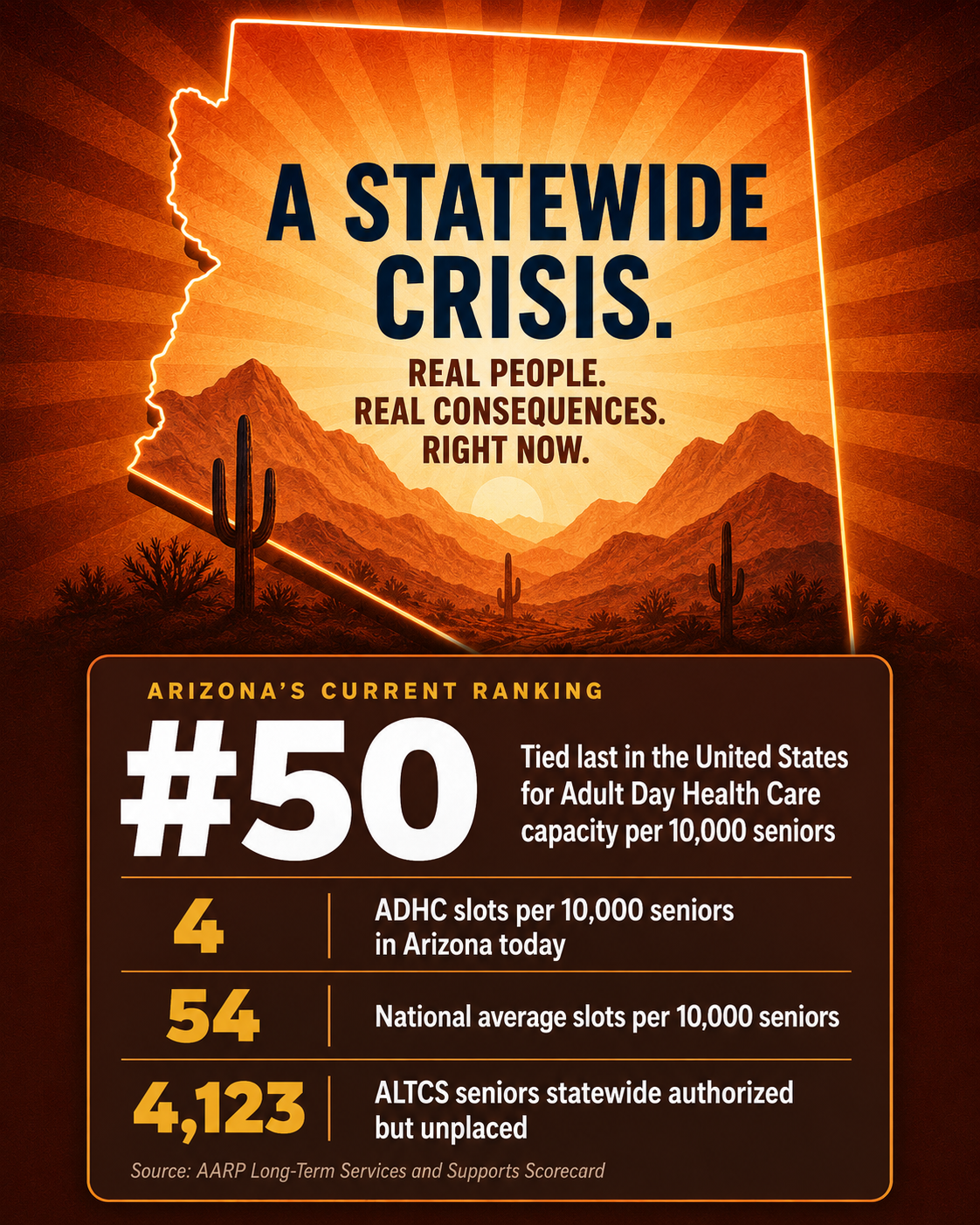
No other state comes close to Arizona's shortage. While the rest of the country has built infrastructure for aging populations, Arizona has been left dangerously behind.
Arizona's Medicaid program — ALTCS-EPD — provides long-term services and supports through contracted health plans. Eligibility and service authorization do not guarantee that a nearby licensed Adult Day Health Care placement is immediately available. When provider capacity is insufficient, authorized members may still be unable to access care. That is the provider-capacity gap LHO is being developed to address.
ALTCS eligibility and authorization create a pathway to care, but access still depends on licensed providers with available capacity, appropriate health plan contracts, and a location the member can reach.
ALTCS does not operate as a single statewide placement waiting list. In practice, an eligible and authorized member may still face delays when no contracted Adult Day Health Care provider has available capacity near the member's community.
MCO support coordinators and care teams often face limited placement options when licensed Adult Day Health Care capacity is unavailable near a member's home. The barrier is not the member's eligibility or the service authorization. The barrier is that licensed provider capacity does not exist nearby.
This is a provider-capacity and access problem. A licensed, contracted facility in the right corridor can help convert authorization into actual care. That is what Lending Hands Outreach is being developed to provide.
Lending Hands Outreach plans to launch in Maricopa County and may expand to three additional Arizona counties as licensing, contracting, funding, and documented demand support responsible growth.
Of the 2,848 unplaced ALTCS seniors in Maricopa County, the highest concentration lives in Maryvale, Avondale, Tolleson, and Laveen — the exact corridor where Lending Hands Outreach is building.
In the West Valley, senior ADHC attendance is not optional for working families. This corridor has the highest caregiver employment dependency of any senior-serving ZIP code cluster in Phoenix. When a family member enters Adult Day Health Care here, it is not a convenience — the caregiver's ability to hold a job depends on it. Without a facility, seniors stay home. Caregivers stay home with them. Employment is lost. Financial stability collapses.
The gap in senior care has not gone unnoticed by the philanthropic and investment community. Funding for organizations like LHO has grown dramatically over the last decade.
Alzheimer's and dementia programming is among the top-three priorities for major health foundations nationally. ADHC centers — which provide structured cognitive engagement and caregiver relief — are a direct match for this investment.
Social isolation prevention has become a federal health priority under the U.S. Surgeon General's advisory framework. ADHC centers address social isolation more cost-effectively than any other intervention.
Healthcare access and workforce development in underserved communities may align with opportunities offered by Arizona health plans and healthcare funders. LHO will evaluate current opportunities only when funding cycles are open and organizational eligibility is confirmed.
CDBG capital funding through the City of Phoenix is specifically available for Public Facility renovation in West Phoenix priority corridors — making LHO's facility acquisition strategy eligible for federal capital investment.
Arizona does not need more authorization paperwork. It needs licensed Adult Day Health Care capacity in the communities where seniors are already approved for care but cannot access services. Lending Hands Outreach is seeking launch funding, donated equipment, facility support, transportation resources, food-service partnerships, volunteer support, and MCO referral alignment to open a compliant ADHC center in the West Phoenix corridor.
Operating reserve, licensing readiness, facility deposits, startup payroll, insurance, and pre-opening compliance costs.
ADA-ready space, furnishings, commercial kitchen support, nurse station setup, safety systems, shelving, tables, and activity supplies.
Wheelchair-accessible transportation resources, vehicle support, routing partnerships, and NEMT coordination capacity.
MCO, AAA, hospital, church, and community-agency partners who can help connect authorized members to available placement.
Lending Hands Outreach has established a compliant service model, identified the West Phoenix target corridor, developed an AHCCCS/ALTCS reimbursement strategy, and is preparing for ADHS Provider Type 27 licensure.
The next barrier is not demand. The next barrier is launch capacity: the operating reserve, facility support, equipment, staffing, and partnership commitments needed to open safely and sustain services during the first months of operation.
Capacity-ranking language is based on Adult Day Health Care capacity comparisons from the AARP Long-Term Services and Supports Scorecard. County demand figures and unmet-demand percentages are planning estimates used by Lending Hands Outreach to identify priority service corridors, evaluate provider-capacity gaps, and support launch planning.
County-level estimates may be refined as MCO contracting, referral activity, provider directory review, and member-placement data become available. The core conclusion remains unchanged: Arizona has a documented Adult Day Health Care capacity shortage, and West Phoenix requires licensed provider infrastructure to convert authorized services into actual care.
Lending Hands Outreach was built specifically to address the West Valley provider shortage. We are not competing with existing providers. We are entering a corridor where the provider network is thin, authorized members need placement options, and MCO partners need reliable licensed capacity close to the communities they serve.
LHO's launch plan combines capacity for up to 25 members daily, a diversified food-support strategy, IRS-recognized 501(c)(3) status, and faith-community infrastructure through the Arizona Ministry Network. Adult Day Health Care meal sourcing remains separate from LHO's controlled QCO/basic-needs program.
The crisis documented on this page is not a background fact. It is the reason this organization exists — and it is precisely the gap we are built to fill.